Markdown 測試 (讀者請不要看)
markdown
# 從物理學的角度來看
從物理的角度來看,可以把樂器拆成很多部分來分析。
例如: 震動源、弦震盪、張力、共鳴箱、...
不要講太多物理了,免得陷入自己的世界。
# code section
```javascript
```
# 從音樂的角度來看
得找其他資料來看看了。不同的切入觀點,會有不同的世界!
不過就算是從音樂的看法,也是各式各樣,那就自己尋找一個稍微系統一點的方式。整理一下想了解的部分。例如: 這個琴是哪個時期發展出來,其標準調音到底怎樣。
 # Mondolin
## 簡介
Classification: (1) String instrument (2) Plucked string instrument
Hornbostel–Sachs classification: 321.321-6 (Neapolitan) or 321.322-6 (flat-backed)
(Chordophone with permanently attached resonator and neck, sounded by a plectrum)
Developed: Mid-18th century from the mandolino
REF:
# Mondolin
## 簡介
Classification: (1) String instrument (2) Plucked string instrument
Hornbostel–Sachs classification: 321.321-6 (Neapolitan) or 321.322-6 (flat-backed)
(Chordophone with permanently attached resonator and neck, sounded by a plectrum)
Developed: Mid-18th century from the mandolino
REF:
## 標準調音
從低音弦開始,標準調音,每組弦依序為GDAE,每組弦的兩根弦之間差八度音,所以8弦則是GGDDAAEE。
REF:
Standard & Alternate Mandolin Tuning
https://goldtonemusicgroup.com/articles/2023/07/07/standard-alternate-mandolin-tuning/#:~:text=Starting%20from%20the%20lowest%2Dpitched,chord%20shapes%20and%20melodic%20playing.
Gibson 1918 A style mandolin
https://www.youtube.com/watch?v=shAcHMs9_80
Mandolin Comparison - Bourgeois, Randy Wood, Doug Clark & The Loar
https://www.youtube.com/watch?v=TzN9ZGdz4oA
------------------------
# Ukelele
## 簡介
Classification: Stringed instrument (plucked, nylon-stringed instrument usually played with the bare thumb and/or fingertips, or a felt pick)
Hornbostel–Sachs classification: 321.322
(Composite chordophone)
Developed: 19th century in Hawaii (introduced by the Portuguese)
REF:
https://en.wikipedia.org/wiki/Ukulele
## 標準調音
一般的Ukelele有4弦。從低音弦開始,正常調音,單弦依序為GCEA (G4-C4-E4-A4)
REF:
HOW TO TUNE A UKULELE
https://www.fender.com/articles/setup/how-to-tune-a-ukulele
也有8弦的Ukelele。從低音弦開始,標準調音,每組弦依序為GCEA,每組弦的兩根弦之間不一定差八度音,所以8弦則是GGCCEEAA。詳細說的話,是(G4-G3, C5-C4, E3-E3, A4-A4),其中G弦跟C弦那兩組,兩根弦之間有差八度,增加音域,但E弦跟A弦那兩組,兩根弦之間沒有差八度,讓tone變豐富。
REF:
8 String Ukulele Tuning Summary
https://coolukulele.com/8-string-ukulele-tuning/
YouTube: 8-string ukulele tuning pitches
https://www.youtube.com/watch?v=flNUCudYkTY
YouTube: My favourite ukulele: Kala 8 String Tenor review
https://www.youtube.com/watch?v=nL9j3Lt3YcY
------------------------
# Guitar
## 簡介
Classification: String instrument (plucked or strummed)
Hornbostel–Sachs classification: 321.322
(Composite chordophone)
Developed: 13th century
REF:
https://en.wikipedia.org/wiki/Guitar
## 標準調音
一般的Guitar有6弦。從低音弦開始,標準調音,單弦依序為EADGBE
也有12弦的Guitar。從低音弦開始,標準調音,每組弦依序為EADGBE,每組弦的兩根弦之間不一定差八度音,所以12弦則是EEAADDGGBBAA。至於那些弦要差八度,那些弦要同樣音高,就看個人喜好。
REF:
How to Tune a 12-String Guitar: Ultimate Visual Guide
https://guitargearfinder.com/guides/how-to-tune-a-12-string-guitar/
YouTube: Stairway to Heaven Live
https://www.youtube.com/watch?v=xbhCPt6PZIU
Jimmy Page用的那把吉他,上半部就是12弦吉他。雖然當年錄影品質不好,但從琴頭的12個調音旋鈕,就可辨認出來。
YouTube: Eagles - Hotel California (Live from the DVD “Farewell 1 Tour - Live From Melbourne“) UHD 4K
https://www.youtube.com/watch?v=NOxnnTcthWs
彈前奏的那把吉他下半部就是12弦吉他。
------------------------
# Lute
## 簡介
Classification: String instrument (plucked)
Hornbostel–Sachs classification: 321
(Composite chordophone)
Developed: Classical antiquity (early lutes)
Middle Ages (modern lutes)
REF:
https://en.wikipedia.org/wiki/Lute
## 標準調音
Lute琴有各種尺寸,不同數量的弦,因此沒有永久的標準調音。
REF:
https://en.wikipedia.org/wiki/Lute
------------------------
# Double string 優缺點
## 優點:
1. 增加音域。差八度的音高,可以提高樂器的音域
1. 豐富tone。同樣的音高,但弦的音色不同,讓tone變得豐富。
## 缺點:
1. 手指壓弦力道要加倍,畢竟一次要壓兩根弦。
1. 手指的按壓位置要壓得更準確,一次要能穩穩地壓到兩根弦。否則只要有一根弦沒壓好,就會漏音了。Buzzing問題又會出現。
------------------------
# 關於樂器分類系統 Hornbostel-Sachs classification
Hornbostel–Sachs 或 Sachs–Hornbostel 是 Erich Moritz von Hornbostel 和 Curt Sachs 設計的樂器分類系統,並於 1914 年首次發表在 Zeitschrift für Ethnologie 上 \[1\]。英文譯本於 1961 年在 Galpin Society Journal 上發表。它是民族音樂學家和管風琴學家(研究樂器的人)使用最廣泛的樂器分類系統 \[2\]。作為線上樂器博物館 (Musical Instrument Museums Online, MIMO) 專案工作的一部分,該樂器分類系統於 2011 年進行了更新 \[3\]。
Hornbostel 和 Sachs 的想法是基於布魯塞爾音樂學院樂器館長 Victor-Charles Mahillon 在 19 世紀末設計的系統。 Mahillon 根據發聲材料的性質將樂器分為四大類:空氣柱 (air column) ; 弦 (string) ; 薄膜 (membrane) ; 和儀器的主體 (body of the instrument)。在此基礎上, Hornbostel 和 Sachs 擴展了馬希隆的系統,使對任何文化中的任何樂器進行分類成為可能。
形式上,Hornbostel-Sachs 是以圖書館杜威十進制分類為模型的。它有五個頂級分類,下面還有幾個級別,總共有300多個基本類別。
目前有五個主要大類:
Idiophones (1)
Membranophones (2)
Chordophones (3)
Aerophones (4)
Electrophones (5) (1940年,由 Sachs 加入)
以這次討論的幾個樂器來看,幾乎都是321這個大類下面。有趣的是小提琴(violin)也在321這個大類下。
| Instrument | Hornbostel-Sachs classification |
| ---------- | ------------------------------- |
| Mondolin | 321.321-6 (Neapolitan) or 321.322-6 (flat-backed) |
| Ukelele | 321.322 |
| Guitar | 321.322 |
| Lute | 321 |
| Violin | 321.322-71 |
REF:
\[1\] Erich Moritz von Hornbostel and Curt Sachs, Systematik der Musikinstrumente, Zeitschrift für Ethnologie **46**, 553-590 (1914).
Link: https://archive.org/details/zeitschriftfre46berluoft/page/552/mode/2up
\[2\] Erich M. von Hornbostel and Curt Sachs, Classification of Musical Instruments: Translated from the Original German by Anthony Baines and Klaus P. Wachsmann, The Galpin Society Journal **14**, 3-29 (27 pages) (1961).
DOI: https://doi.org/10.2307/842168
\[3\]
https://mimo-international.com/MIMO/
https://cimcim.mini.icom.museum/wp-content/uploads/sites/7/2019/01/H-S_20classification_20final_20version_20_282013_29_20without_20editorial_20markings-2.pdf
Wikipedia: Hornbostel–Sachs
https://en.wikipedia.org/wiki/Hornbostel%E2%80%93Sachs
Wikipedia: List of musical instruments by Hornbostel–Sachs number
https://en.wikipedia.org/wiki/List_of_musical_instruments_by_Hornbostel%E2%80%93Sachs_number
Wikipedia: Violin
https://en.wikipedia.org/wiki/Violin
其實樂器分類這檔事,從過去就有很多人嘗試。更多資料可以參考維基百科的"Musical instrument classification"。
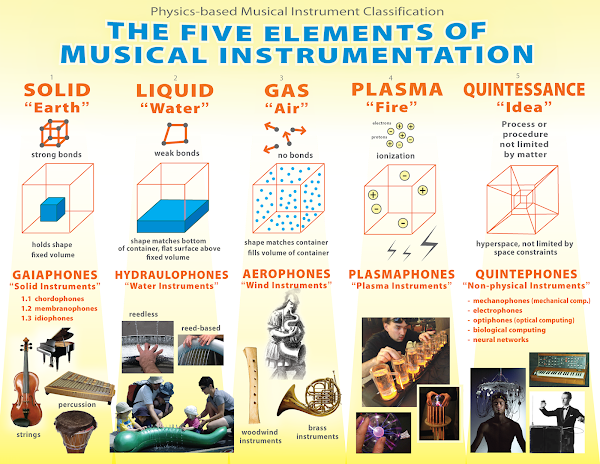
多看了一下,也有人把物理跟四大元素(風火水土)類比,來進行樂器分類。挺有趣的。

Wikipedia: Musical instrument classification
https://en.wikipedia.org/wiki/Musical_instrument_classification
------------------------
# 關於樂曲 Asturias (Leyenda)
阿斯圖里亞斯傳奇 (Asturias (Leyenda)) 是 Isaac Albéniz 於 1892 年創作的鋼琴獨奏曲。調性為g小調,演奏全長約六分鐘。這首曲子的吉他改編版十分著名,為古典吉他的演奏曲目之一。
鋼琴版欣賞:
Albéniz: Suite española No. 1, Op. 47 - Asturias (Leyenda)
https://www.youtube.com/watch?v=CQruHcDza9c
1987年出版,只有聲音,沒看到錄影(也許是沒找到)。這是我第一次聽到,當時就感受到原始鋼琴版的音域廣,並且其震撼力更強於吉他版本。
ISAAC ALBÉNIZ- ASTURIAS Luis Fernando Pérez, piano
https://www.youtube.com/watch?v=-P8BQVhOv5A
Asturias Albeniz (by Isaac Albeniz) played by Anastasia Huppmann
https://www.youtube.com/watch?v=8aKtGrjFVhI
這首曲子沒辦法直接在吉他演奏。鋼琴原版所使用的音域遠廣於吉他的琴弦,而且調性並不適合吉他。
這很容易理解,光看鋼琴演奏家在高潮處都是雙臂大鵬展翅在彈鋼琴,就知道音域已經橫跨N個八度,吉他音域沒那麼廣。
許多人把第一次的吉他改編歸功於 Francisco Tárrega,他把此曲改編為e小調,也是後來最廣為人知的調性。 但根據吉他手兼吉他學者 Stanley Yates 的說法,這首曲子的第一次吉他改編很可能是由 Severino García Fortea 完成的,儘管 Andrés Segovia 的改編最著名也最有影響力。
Francisco Tárrega演奏的版本,現在可能聽不到,因為當時錄音技術仍在發展中。Andrés Segovia 的版本,網路上有一堆可以看。
吉他版欣賞:
Leyenda by Albeniz in HD - Andres Segovia
https://www.youtube.com/watch?v=lCeebWgjrrU
很神奇的錄音。當年的錄音技術,竟然能做到"餘音繚繞"。是否是因為彈奏地點的音場回聲效應,就不得而知。
Asturias (Isaac Albéniz) - Alexandra Whittingham
https://www.youtube.com/watch?v=V2F6RswMYpw
影片品質很好,達到1440p,可以看到很多演奏細節。值得學習參考。
例如: 封閉和弦,食指力量不足時,使用中指壓在食指上,加強力量,避免雜音。
揉弦時,大拇指離開指板背面,意思就是不使用手的握力來揉,而是使用整隻手臂移動來揉。
REF:
古典音樂史上最早的錄音x保存聲音的歷史大公開!
https://inintomusic.asia/recording-history/
史上首次錄音|科學史上的今天:12/6
https://pansci.asia/archives/129905#google_vignette
# 感想
音樂確實可以打開另一個想像的世界!

Comments
Post a Comment